Use the uploaded image strictly for face and identity reference — preserve exact facial features, hairstyle, skin tone, and proportions without any modification.
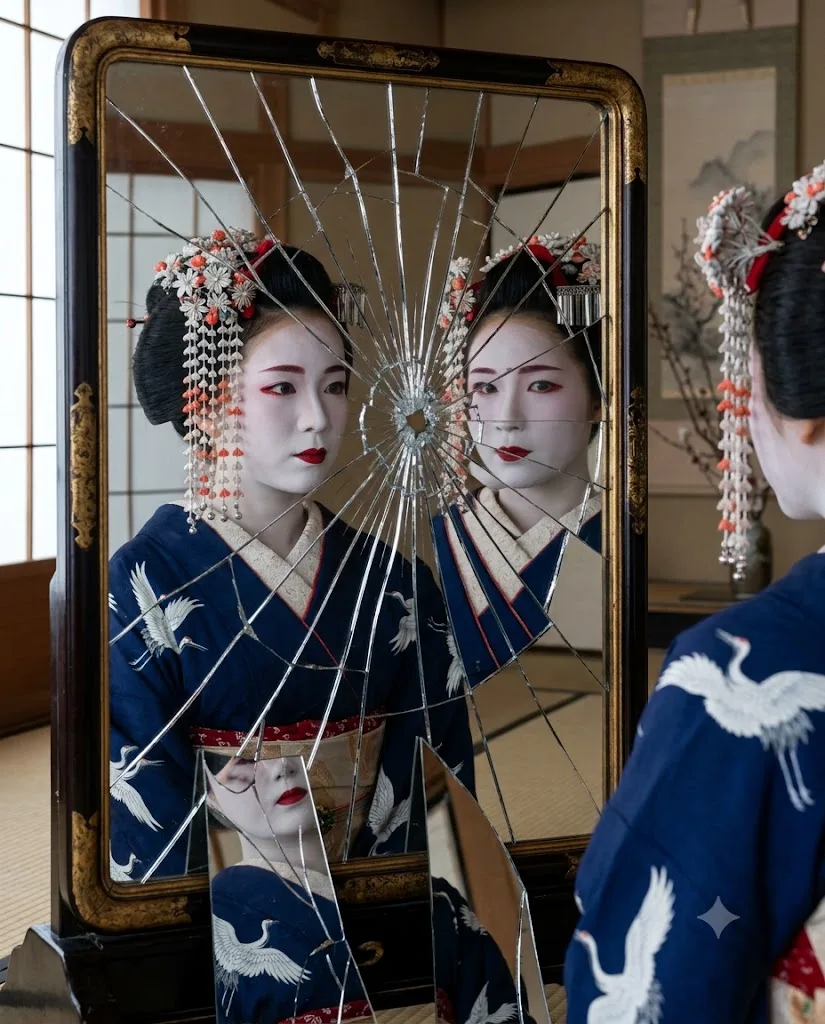
Create a super ultra-HD 8K maximum-resolution hyper-realistic portrait of a maiko — a Kyoto apprentice geisha — standing before a large antique mirror that has shattered from a single central impact point, its cracks radiating outward in a perfect spider-web pattern across the entire glass surface. She is not looking at the camera. She is looking at her own fractured reflection — her face multiplied into dozens of triangular mirror shards, each fragment reflecting a slightly different angle of her face and costume simultaneously.
Her appearance is immaculate and must be rendered at the highest possible detail resolution:
— Shironuri white face paint applied with a brush over a wax base, its surface not completely smooth — under extreme magnification the fine brush strokes are visible, the slight texture of the wax layer beneath, the precise border where white paint ends and natural skin begins at her hairline and jaw, the exact soft edge where the paint feathers at her neck
— Kuchibeni lip paint in deep scarlet, applied in the traditional reduced-lip style — smaller than her actual lips, creating an upper and lower petal shape. The paint surface catches light differently from the white base — slightly more reflective, the exact color gradient from lip center to edge
— Eye makeup: thin precise black liner at the upper lid in the maiko style, the line's edge under 8K resolution showing individual brush strokes, the red applied at the outer eye corner visible as a separate layer beneath the black
— Her kanzashi hair ornaments: dangling Januaray-style with long chains of silver, coral beads, and fabric flowers — each bead individually rendered, each chain link separate, each fabric flower petal with its own slight crush where it has been handled
— Her furisode kimono: deep midnight blue silk with a pattern of hand-painted white cranes in flight — each crane individually painted, no two identical, the brushwork visible on each
The mirror frame is lacquered dark wood with gold leaf inlay, the gold leaf in slight relief from the lacquer, some sections worn from age. The cracks in the glass are the image's structural element: they cross her reflected face in unpredictable angles, splitting her into fragments. Some fragments have dropped from the frame and lean against the mirror's base — in these displaced shards her reflection continues at the wrong angle, a surrealist displacement of her face.
The room behind her is a traditional Kyoto ochaya tearoom — tatami floor, a single scroll painting on the tokonoma alcove, a vase of winter plum branches. All softly out of focus.
The lighting: a single paper shoji screen to her left transmits soft diffused winter daylight — flat, even, and completely without shadows. The kind of light that shows everything.
Every mirror crack geometry, every crane brushstroke on the kimono, every kanzashi chain link, every paint layer on her face — rendered at absolute microscopic maximum resolution. This is the defining technical standard of the image.
85mm portrait lens, f/1.4 aperture, ultra-shallow depth of field, DSLR quality, photorealistic multi-layer makeup and silk texture, cool diffused Japanese winter light color grading, zero grain.
Aspect ratio 4:5.
Tip: Copy this prompt and paste it into Google Gemini or Nano Banana, upload your image, and generate stunning results.